Showing posts with label University. Show all posts

Thursday, 21 June 2012

Best books for nursing students

Hello readers!!
Today I'll be chatting about the nursing books i could not live without (Well... okay... I COULD live without them but it would be hard...). These books are my favourite by-the-way. I have so many i love but these are the main ones! ^   ^ Head down to your uni library if you are interested. I haven't linked them to Amazon or anything because almost every uni library will have these books. Do you really want to waste £130 of your student bursary on one book? That's what I thought... Just search your library catalogue. It saves pennies. So, here we go. In no paticular order...


The Royal Marsden of Clinical Nursing Procedures
Such an amazing book but SO heavy -_-... This is the most important book of your training though, whcih regards to learning clinical procedures anyway. This has pretty much EVERY nursing procedure but it's great to learn from because its set out well, with great diagrams and in an easy-to-read way. Probably not a good idea to buy this or some of the other books mentioned in this post as many, if not all of these are very expensive (some over £100...) Just head down to your university library. More often your uni library will have withdrawn books and you will be able to take them home for free. Anyway, I love this book so get one if you can!
 
British National Formulary
This book is a must for when you are on the wards! It simply lists all drugs and their indications, side effects etc. I believe they are released a couple times every year (March and Sept, I think) which is great because it means they are always up-to-date. Plus, they are always such pretty colours!! Anyway, don't panic if you don't have one, every ward has at least three or four. You don't have to pay Amazon prices either. Just run down to your pharmacy dept. and ask if they have any they are chucking out. (They always want up-to-date ones obviously). So, get your hands on one!! 

Gray's Anatomy
Every nurse needs to have some knowledge about A&P and this book is amazing! It's pretty heavy for the layman mentally and physically (It'a a BIG book...) but it's a must for any student of biology or healthcare.


Principles of Anatomy & Physiology
This book is actually available as two separate volumes and is actually one of the best A&P books I've read. It covers almost everything you need to know as a student nurse and is perfect for assignments. This book was actually recommended by the A&P lecturers and I found so many copies in the library. Only problem was that I would have to stay in the stacks and flick through the book to make sure I had the right volume with the right topics in before taking it out! Other than that, highly recommended!


The Incredibily Easy! Series
I LOVE this series because, being a first year, some aspects of the course and of your training are quite daunting. This series helps to clarify some of the harder topics. Each chapter starts with the very basics and gradually delves into the deeper and more analytical stuff. The text is broken up into smaller paragraphs, making it easy to read. And text is also accompanied by cartoon pictures which is quite cool. There are quite a lot of books in this series and so far I've only read about three/four but I hope to read them all eventually! There are books on: Wound care, critical care, clinical skills, fundamentals of care, mental health, nursing pharmacology, assessment, nutrition, paediatrics and many more! Check them out!  


Nursing Calculations
Although this is a book of little pages but is very easy to get through. It simply comprises of a lot of drug calculations and is set out like a maths textbook. But it starts with the easy stuff and gradually gets to the more difficult calculations. It's easy to carry around, weighs practically nothing and the answers are at the back which helps you to check what ones you got right or wrong... Anyway, this is a MUST! I love it!


The Student Nurse Handbook
This was one of the very first books that I took out at the library and it's brilliant!! It helps students to gain an insight into nursing before going on their first placement and it really did help me a lot. It gave me insight regarding what to expect once I stepped on the wards. I actually kept this in my bag during lectures in case I had a spare minute to have a read and I'd also read it on the bus. It's easy to carry around and cover a multitude of topics. I also used this for my interprofessional module!! Like gold dust!!


Well, I suppose that covers it! I hope you have found this post useful! I've been under a lot of stress lately what with so many assignments and trying to arrange my next clinical placement (which is actually with a district nurse, buzzing! lol) I hope you are well and I hope you have time to research into these books because I love them and have found them so beneficial!
Take care!

Emily

Monday, 2 April 2012

Procrastination & Stress

Good evening!
Well, this is my first post for April 2012! How exciting! I never thought that I would last five minutes writing this blog! I guess I'm really enjoying it now! (:
First off, how do you like th new look? I decided I'd be adventurous and change the template and my profile picture!! haha! (I'm not totally sure that blue carnations even exist although i have heard that they do in Japan...)
It's also finally the Easter school holidays which means two weeks of rest! Ahahaa.. NOT! More like two weeks of worrying about assignments, portfolios and clinical placement and hardly being able to breathe!!! OK.. calm down... breathe...
In this post I'm gonna be talking about procrastination and stress and how to overcome them.
I know I haven't been doing much theory stuff but I'll get to that all later! I want to deal with the issues that are bugging me at the minute so here goes...

Procrastination

What is it?

Putting off work 'til a later date. Saying to yourself 'Yep, I'll do that later' and actually not getting around to doing it! I shamefully do this too much...

Why do we do it?
Because maybe it's easier to pretend it isn't there or it isn't actually happening rather than addressing it straight away. It keeps the stress at bay by pretending it doesn't exist... well, until you are a week before the deadline! Also, we all know the feeling of fearing failure. And perfectionism is certainly not uncommon!

How can we overcome it?
OK, here are my tips...
1. Plan ahead: Write yourself a day-by-day study plan over the school holidays and over the week/weekends including what you are doing, where and at what time. This way you will have time for adequate breaks and rest and you'll also get the important stuff DONE!
2. Write it where you'll see it: Write yourself reminders for the deadline. On the date two weeks before the deadline on your calendar, write 'two weeks 'til deadline' or something. This helps you to get the remaining time in your head and it also helps you not to forget!! Also, write your study plan up in a proper diary. Don't write it on your phone. I know so many people who wrote things on the planner on their phone and forgot anyway because they only use their phones for Facebook...
3. Make studying enjoyable: Or at least as enjoyable as it gets. Don't just copy things out of a textbook. Watch videos on Youtube on the subject, Draw pictures or diagrams, make a presentation on it or write a blog or journal like I do (:
4. Recognise that no-one is perfect: This might be the hardest to do and it also may take the most time. Recognising that everyone will make mistakes is hard but eventually it is one of the only ways to cure procrastination.

Stress

What is stress?

Feeling overly anxious about something or feeling powerless and hopeless. We feel that we've lost control of events in our life.

Why does it happen?
Unfortunately, stress affects us all and apparently is occurs because of a build up of 'cracks' over time. Little 'cracks' start to appear everytime something mkes us anxious which eventually leads to us 'crashing down' or getting totally stressed about it whether it's something to do with assignments or exams or something else.
Another explanation for stress in the 'fight-or-flight' response. If you studyed A Level Psychology, you'll probably know about this. This theory suggests that when someone perceives a threat, it quickly releases hormones to help it survive. We experince this almost everytime something unexpected happens or something happens that stops us from reaching our goals. However, it needs to be controlled in order to remain calm in the short term and to maintain good health in the long term.

How can we keep calm under pressure?
Here are a few tips I thought up...
1. Keep a journal or diary: Hmm... This one has come up twice now! I have kept a diary before and I found it did help me a great deal in controlling my emotions.
2. Breathe: There are a range of different breathing techniques you can do to maintain emotional control. Unsurprisingly, I'm a bit of a trekkie and I'm a huge fan of Vulcan Meditation. Try it for yourself. Also, Yoga it good for breathing techniques. Breathing techniques are great for helping you to control your emotions under pressure because it is easy to do and remember and you won't look weird for doing it!
3. Exercise: I love exercising! I have just started running again! The area in which I live is perfect for running because there are small pathways along the river and the fields near my house. So, it's great twice a week to go running amongst nature! It also encourages you to drink more fluids, breathe deeper, eat healthily and build up your physical and psychological strength.
4. Get a stress ball: These are great fun, if not helpful in relieving stress!
5. Watch a movie: I always watch anime when I'm in a mood. Dunno why... probably because it makes me laugh! So, watch a comedy, it really works!
6. Massage: This helps to relieve some of the tension stress causes in your muscles.
7. Have a relaxing bath: Having a nice warm bath always relaxes me! Grab some scented candles too!
8. Listen to music: Above all, I love listening to music especially when I'm stressed or frustrated. However, there are two problems with this. If you listen to music alone, it could make you feel more isolated because obviously you won't be talking to anyone. Secondly, depressing music will just make you feel worse! Why not try listening to classical music. I love classical. I'd suggest Ludovico Einaudi, Craig Armstrong, Loreena McKennitt or Two Steps From Hell. I know so many people think Classical is boring but try to be open minded. Classical is so underrated. If not, try more acoustic or country bands/artists such as Boyce Avenue, Rascal Flatts, Nickelback, Tracy Chapman or Carrie Underwood. Why not try movie soundtracks too. Most are classical but they are awesome! Have a look at Carter Burwell (soundtrack for Twilight), John Powell (soundtrack for How To Train Your Dragon), Yoshihisa Hirano and Hideki Taniuchi (soundtrack for Death Note anime), Stephen Flaherty (soundtrack for Anastasia) and Howard Shore (soundtrack for Twilight: New Moon). Also you could have a look at Christian music. The bands/artists I like include: Fireflight, Skillet, Flyleaf, The Devil Wears Prada, Paige Armstrong, Beckah Shae, Britt Nicole, Pillar, Plumb, Disciple, Superchick and RED. I could go on all day! Just try different types of music. It will calm you down and make you happier!

So, those are my tips!
I hope you enjoyed this post! I'll be back with more theory later on!
See you later!

Emily

Thursday, 8 March 2012

Holistic Nursing

Hello ^ ^
Long time no see (; LOL!
Tonight I'll be talking about holistic nursing.

What is holistic nursing?
• Relationship-centred care
• Recognising body-mind-emotion-spirit-environment principles in daily life and in clinical practice
• Desire to do good – not performed for the sake of the law or because of duty
• Paying attention to all aspects of an individual – the physical, social, mental and emotional person
• Communicating verbally and non-verbally

The practice process is based on six main principles...
• Assessing
• Diagnosing
• Identifying outcomes
• Planning care
• Implementing plan of care
• Evaluating

The caring process involves...
• Recognising the totality of the human being – the interconnectedness of the body, mind, spirit and emotion
• Focusing on how the individual is cognitively perceiving and emotionally dealing with the illness
• Focusing on effect on persons family, social relationships and economic resources
• Focusing on care interventions that promote healing, peace and comfort

Holistic Assessments
• Include physical, mental, emotional, cultural, sexual, spiritual and transpersonal and energy field assessments
• Energy field assessments are based on the concept that all beings are composed of energy and congestion of this energy will create disharmony and disease
• Spiritual assessments – religious beliefs and a person’s purpose in life. Ask questions about their sense of peace, what brings them joy, strength and hope.
• First ask an individual: “What do you think is happening/going on with you?” And then: “What do you think would help?”
• Help the person to identify risk factors such as lifestyle, habits, beliefs, values, family or personal history
• Focus on individual’s goals rather than the nurses
• Therapeutic plans of care respect person experience and uniqueness of each healing journey
• Holistic nurses respect that outcomes may not be expected as they may evolve differently


I know some of my posts seem quite short and to the point, without much detail but I promise that as the year progresses I will continuously add detail as I go along! You'll pretty much be able to see my knowledge grow over the years, I promise ^^
Oh, also I did a little research earlier. It might sound silly but I actually did not know what the different was between diagnosis and prognosis. If you didn't know here you go:

Diagnosis: what illness or injury a patient has.

Prognosis: the outlook/forecast/decision of how to TREAT the diagnosis. Good prognosis = you are likely to recover. Poor prognosis = you are not likely to recover.

Bye!!

Emily

Wednesday, 7 March 2012

A&P Part One: The Endocrine System

Hello everyone!
I know it's been about a week since my last post but I thought I'd wait a bit so I could make this post more interesting!!
Good news by-the-way! We've finally moved onto the more exciting stuff - Life Sciences!! xD Yey!! haha!
In this post, as you can probably guess from the title ^^, I will be discussing the all-important and absolutely astonishing endocrine system! (Quick note: I was originally going to be talking about Endocrine, Renal *AND* Respiratory in this one post but... I started writing and realised that there was just *SO* much to write about on each system - why does the human body have to be so complex?!?!? Ahaa - So I've decided to split this post into three A&P parts. So, A&P part two and three will follow soon! Enjoy!!)

The Endocrine System
This vital system in our body consists of widely separated endocrine glands which secrete hormones. Hormones, as you may recall from GCSE biology, are 'messenger' substances produced in one part of the body but regulates the activity of cells in other parts of the body. Most hormones enter interstitial fluid and then the bloodstream. The circulating blood then delivers hormones to cells throughout the body. Hormones exert their effects by binding to receptors on or in their 'target' cells and their levels are greatly influenced by factors such as stress, infection and changes in balance of fluid and minerals in the blood. If, however, a hormone is present in excess, the number of target-cell receptors may decrease. This is called 'down-regulation'. In contrast, when a hormone is deficient, the number of receptors may increase. This is known as 'up-regulation'.
The Endocrine system is vital for regulating mood, growth and development, tissue function and metabolism, sexual function and reproductive processes. Responses of the Endocrine system are also slower than the responses of the nervous system. Although it may take seconds for a hormone to act, most take several minutes or more to cause a response. And while the nervous system acts on specific muscles and glands, the influence of the Endocrine system is much broader as it helps regulate virtually all types of body cells.

Endocrine Glands
Endocrine glands secrete hormones into the interstitial fluid surrounding the secretory cells. The hormones then diffue into the blood capillaries and the blood carries them to target cells throughout the body. Because they depend so much on the cardiovascular system to distribute products, the endocrine glands are some of the most vascular tissues in the body.

The Endocrine Glands & the hormones they produce...

Pituitary Gland
Human Growth Hormone (HGH)
-Chemical Nature: Protein.
-Mode of Action: Cyclic AMP.
-Important Roles: Stimulates protein synthesis and release of energy from fats.

Thyroid Stimulating Hormone (TSH)
-Chemical Nature: glyco-protein.
-Mode of Action: Cyclic AMP.
-Important Roles: Stimulates production and release of thyroid hormones.

Adrenocorticotrophic hormone (ACTH)
-Chemical Nature: Peptide.
-Mode of Action: Cyclic AMP.
-Important Roles: Stimulates production and release of adrenal cortex hormones.

Follicle stimulating hormone (FSH)
-Chemical Nature: glyco-protein.
-Mode of Action: Cyclic AMP.
-Important Roles: Maturation of follicles in females and production of sperm in males.

Luteinizing hormone (LH)
-Chemical Nature: glyco-protein.
-Mode of Action: Cyclic AMP.
-Important Roles: Triggers ovulation and development of corpus luteum.

Prolactin (PR)
-Chemical Nature: Protein.
-Mode of Action: --
-Important Roles: Stimulates milk production by mammary glands.

Melanocyte stimulating hormone (MSH)
-Chemical Nature: Peptide.
-Mode of Action: Cyclic AMP.
-Important Roles: Increases skin pigmentation.

Anti-diuretic hormone (ADH)
-Chemical Nature: Peptide.
-Mode of Action: Cyclic AMP.
-Important Roles: Stimulates reabsorption of water by kidney tubules.

Oxytocin
-Chemical Nature: Peptide.
-Mode of Action: --
-Important Roles: Stimulates contraction of the uterus.

Pineal Gland
Melatonin
-Chemical Nature: Amine.
-Mode of Action: --
-Important Roles: Possible inhibitory action on ovaries.

Thyroid Gland
Thyroxin
-Chemical Nature: Amino Acid.
-Mode of Action: Cyclic AMP.
-Important Roles: Increases metabolic rate, stimulates growth in infants.

Thyrocalcitonin
-Chemical Nature: Peptide.
-Mode of Action: --
-Important Roles: Promotes calcium absorption by bones.

Parathyroid Glands
Parathyroid hormone (PTH)
-Chemical Nature: Protein.
-Mode of Action: Cyclic AMP.
-Important Roles: Promotes calcium absorption from intenstine, stimulates calcium release from bones.

Thymus Gland
Thymosin
-Chemical Nature: Peptide.
-Mode of Action: --
-Important Roles: Possible influence on B-lymphocytes.

Pancreas (Islets of Langerhans)
Insulin
-Chemical Nature: Protein.
-Mode of Action: Cyclic AMP.
-Important Roles: Stimulates absorption of glucose into liver and muscle cells, formation of glycogen.

Glucagon
-Chemical Nature: Peptide.
-Mode of Action: Cyclic AMP.
-Important Roles: Increases blood glucose level, breakdown of glycogen.

Adrenal Glands

The Cortex:
Mineralocorticoids, aldosterone

-Chemical Nature: Steroid.
-Mode of Action: Gene activation.
-Important Roles: Stimulates reabsorption of sodium ions by kidney tubules, reduces reabsorption of potassium ions.

Glycocorticoids: Hydrocortisone, Corticosterone, Cortisone

-Chemical Nature: Steroid.
-Mode of Action: Gene activation.
-Important Roles: Reduce effects of stress responses.

The Medulla:
Adrenalin (80%), Noradrenalin (20%)

-Chemical Nature: Amine.
-Mode of Action: Gene activation.
-Important Roles: Increased heart and breathing rates, other 'fight or flight' responses.

Ovary
Oestrogen

-Chemical Nature: Steroid.
-Mode of Action: Gene activation.
-Important Roles: Development of female sexual characteristics, repair of uterus lining.

Progesterone

-Chemical Nature: Steroid.
-Mode of Action: Gene activation.
-Important Roles: Development o uterus ready for implantation.

Testis
Testosterone

-Chemical Nature: Steroid.
-Mode of Action: Gene activation.
-Important Roles: Development of male sexual characteristics.


The Master Gland
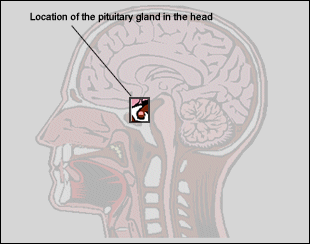
Attached to the hypothalamus in the brain, hangs the pituitary gland. This gland is nicknamed 'the master gland' because it stimulates all other hormone-producing glands to produce their own hormones. And while it is vital in the endocrine system, amazingly it is only the size of a pea!
It is comprised on two parts - the anterior and posterior lobe (see first picture in post). The anterior lobe secretes six hormones (which are named above) and is influenced by the hormones from the hypothalamus. The posterior lobe stores hormones that are from the hypothalamus, they are released when needed. Antidiuretic hormone (ADH) and oxytocin are produced in the hypothalamus and transported by axons to the posterior pituitary.

Feedback Mechanisms
The endocrine system uses cycles and negative feedback to regulate physiological functions. Negative feedback regulates the secretion of almost every hormone. Cycles of secretion maintain physiological and homeostatic control. These cycles can range from hours to months in duration.

This 'feedback' mechanism involves the hypothalamus, the pituitary gland and the target gland to control hormone production. A feedback system promotes to release of another hormone (positive feedback) or can inhibit its release (negative release). This mechanism helps to maintain the body's balanced functioning.

Example of how it works...

1. Responding to levels of the Thyroid hormone, the hypothalamus make TRH (Thyrothropin-releasing hormone). This stimulates the anterior pituitary gland to release TSH (Thyroid-stimulating hormone). The thyroid gland is then triggered to produce hormones.

2. If the Thyroid hormone levels are too high, negative feedback alters the hypothalamus so that it produces less TRH. A lower level of TRH results in a reduced level of TSH. So the Thyroid responds by producing less hormone.

3. If the Thyroid hormone levels fall too low, the feedback mechanism is weakened. In response, the hypothalamus makes more TRH; TSH rises so that the levels of Thyroid hormone also rise.

Chemical classes of hormones
OK, so above you can see that I have (in the description of glands and the hormones they produce) mentioned whether hormones were steroids, amines, peptides or proteins. Well, now I'm going to explain what all this means. So, here goes...

There are two main types of hormones
* Lipid (fatty acids) soluble hormones: i.e. steroid hormones which are derived from cholesterol.
* Water soluble hormones:
Amine hormones: synthesised by removing the CO2 molecule and modifying amino acids. Example: Tyrosine.
Peptides and proteins: Amino acid polymers (large molecules with high melting and boiling points). Smaller peptide hormones consist of 3-49 amino acids while the larger consist of 50-200. Examples of peptides: oxytocin/ADH. Examples of proteins: HGH and insulin.

Adding to this, hormones can either be...
* Circulating hormones: Pass from secretory cells that make them, then into interstitial fluid, then into the bloodstream. Circulating hormones may linger in the bloodstream but are finally excreted by the kidneys.
* Local hormones: Act locally on neighbouring cells (or on the same cell that secreted them) without first entering the bloodstream. In comparison to circulating hormones, local hormones are inactivated quickly. Hormones acting on neighbouring cells are called 'paracrines'. Those acting on the same cell that secreted them are called 'autocrines'.

Hormone Transportation
*Water Soluble: Molecules circulate in blood plasma and are not attached to other molecules.
*Lipid soluble: Bind to transport proteins.

These transport proteins (which are made by cells in the liver) have three functions...
1. Make lipid soluble hormones temporarily water soluble which increases their solubility in the blood.
2. Delay passage of small hormone molecules through the filtering system in the kidneys which slows the rate of hormone loss in the urine.
3. provide ready reserve of hormone already present in the bloodstream.

Actually about 0.1-10% of molecules of lipid soluble hormones don't bind to transport proteins. This is called 'free fraction'. It is the free fraction that diffuses out of capillaries, binds to receptors and triggers responses.

Clinical connection: Peptide/protein hormones such as Insulin need to be taken by injection. Taken orally, the digestive enzymes destroy them by breaking their peptide bonds. Steroid/thyroid hormones both are effective when taken orally as they are not split apart during digestion and easily cross the intestial lining because they are lipid soluble.

Mechanism of hormone action
The endocrine system acts by releasing hormones that in turn trigger actions in specific target cells. Receptors on target cell membranes bind only to one type of hormone. More than fifty human hormones have been identified; all act by binding to receptor molecules. The binding hormone changes the shape of the receptor causing the response to the hormone. There are two mechanisms of hormone action on all target cells.


Water Soluble
Water soluble hormones do not enter the cell but bind to plasma membrane receptors, generating a chemical signal (second messenger) inside the target cell. Five different second messenger chemicals, including cyclic AMP have been identified. Second messengers activate other intracellular chemicals to produce the target cell response.


Lipid soluble
The second mechanism involves steroid hormones, which pass through the plasma membrane and act in a two step process. Steroid hormones bind, once inside the cell, to the nuclear membrane receptors, producing an activated hormone-receptor complex. The activated hormone-receptor complex binds to DNA and activates specific genes, increasing production of proteins.


Phew! I know this was a long one, guys! Probably the longest one yet! And I have to tell ya - we're not even finished yet!! There's so much that I haven't said in this post!! Plus we still have Renal and Respiratory!! O_o IKR! LOL!
Anyway, I hope you are all well and I hope you enjoyed this post!
I find all this fascinating! I love learning about how the human body works. It's truely amazing that it all goes on without us consciously knowing about it!!
Anyway, ttyl!!

Emily

Thursday, 1 March 2012

Reflection, Record keeping, Confidentiality and Drug Calculations

Hi guys!
Today I'll be covering four topics in this one post. Enjoy!

Reflection
Reflection is when you think about an aspect of your professional development as a student nurse. It is considered as very important to your learning and experience. It helps nurses to evaluate their own practice and performance. Bengtsson (1998) suggested that nurses need to learn by these experiences and, by doing so, would become more competent and therefore more able to teach others. Callister (1993) sees reflection on clinical events as an expansion of cognitive learning and suggests that the use of professional journals to record events, and reactions to these events, shapes the future of care delivery. This certainly shows that reflection is vital to a students learning and understanding.
Reflection involves meditating about the experiences of a day in practice, analysing and evaluating decisions made, using self-assessment to improve continually, therefore focusing on lessons learned whilst maintaining objectivity.
This can be done through a SWOT analysis. You may have heard of this before... Using SWOT analysis helps us to consider our possible strengths, weaknesses, opportunities and threats.
We can also use Gibbs Reflective Cycle. (See Image)


Potential barriers to reflection
*Stress
*Lack of honesty
*Time
*Insecurity
*Lack of/too much confidence
*Fear
*Bad/lack of feedback
*Stubborn/narrowmindedness
*Arrogance

So, overall, reflection must be done on a regular basis to be beneficial to nurses. And while reflection is fairly commonplace, it's also a good idea to keep checking this against currently theory and acceptable practice.

Record keeping
In nursing, record keeping is very important as it must reflect high standards of clinical care and health care records must keep continuity of care and accurate account of treatment. Records are therefore used as a vehicle for communication between other health care professionals.
What Health Care Records include
*Clinical notes
*Photos (to observe the development of a complaint)
*Letters
*Print outs from monitoring equipment
*Incident reports
*Emails
*X-rays
*Lab reports


Principles of record keeping
*Handwriting must be legible for others to read.
*Must be signed inluding name and job title printed alongside first entry.
*The date and time must be recorded.
*Records must be in chronological order.
*Language must be easily understood (no jargon!!) and must be accurate with clear meaning.
*Records should identify risks and problems and the possible actions that were taken.
*However, the records must never be altered or destroyed.

Confidentiality
This relates closely to the last topic really.
Confidentiality is defined as 'the duty to maintain confidence and thereby respect the privacy of patients health information'.

Regarding confidentiality, the Nursing and Midwifery Council (NMC) states that...
1. You need to be fully aware of the legal requirements and guidance regarding confidentiality, and ensure your practice is in line with national and local policies.
2. You should not discuss the people in your care in places where you might be overheard. Nor should you leave records, either on paper or on computer screens, where they might be seen by unauthoried staff or members of the public.
3. You should not take or keep photographs of any person or their family, that are not clinically relevant.
So, yeah. It's pretty serious stuff.

Drug Calculations
I love this bit. (;

Drug calculations are important in nursing because obviously administering the wrong dosage of medication could potentially kill someone! (Extreme, maybe, but it could happen...)

Here is a little guide for converting metric units of measure...


                   x1000                        x1000
Grams (g) -------> Milligrams (mg) -------> Micrograms (mcg)
Grams (g) <------- Milligrams (mg) <------- Micrograms (mcg)
                   /1000                        /1000

So...
1g = 1000mg
And...
1mg = 1000 mcg

Moving the decimal point
x1000
Move dm 3 places right.

/1000
Move dm 3 places left.

So...
0.04g = 40mg = 40 000mcg

Test yourself on these conversions...
1. 30 g = ____ mg
2. 2 mg = ____ mcg
3. 800 mg = ____ g
4. 50 mcg = ____ mg
5. 20 mg = ____ g
6. 6500 mcg = ____ mg
7. 900 mg = ____ g
8. 0.1 mg = ____ g
9. 0.25 g = ____ mg
10. 125 mg = ____ g

For more information and more test questions check out this website and this book.

Another tip I have is to go into your local drug store (EG. Superdrug, Boots, Tescos, Asda, Wilkies...) and have a little look at the labels of some medication. Imagine the drugs being prescribed to a patient and think up some possible prescriptions in your head. It's all good practise!


Oral Medication Calculations
Kind of the same as before but now we must administer the right amount of drug to meet the specific needs of a patient.

Example:
A patient prescribed 2.5 mg of ramipril orally. Each tablet contains 1.25 mg. How many tablets should be given? Answer = 2.

Another Example:
How many Metronide 200 mg should be given for a prescription of Metronidazole 400 mg orally? Answer = 2.

Further Example:
How many 30 mg tablets of Codeine should be given for a prescription of Codeine 45 mg? Answer = 1.5.

Test yourself on these calculations...
1. A client is ordered 300 milligrams of Thioridazine. 100 milligram tablets are available. How many tablets will you give?
2. A client is ordered 1 milligram of Diazepam. 2 milligram tablets are available. How many tablets will you give?
3. A client is ordered 0.5 milligrams of Digoxin. 250 microgram tablets are available. How many tablets will you give?
4. A client is ordered 30 milligrams of Diltiazem hydrochloride. 60 milligram tablets are available. How many tablets will you give?
5. A client is ordered 62.5 micrograms of Benztropine Mesylate. 0.25 mg tablets are available. How many tablets will you give?

And that's it! I know it was quite a long post again!
Just to let you know I'll be continually updating my blog of the topics I post about, since in Nursing you are constantly learning new things. I'll especially be updating about what I've learnt in reflection and drug calc. In later posts I hope to discuss dosages of meds for injections and intravenous infusion which I think will be very exciting! ;D
I hope you've enjoyed this post! It has taken me a long time to type all this up! ^ ^
Take care.

Emily

Tuesday, 28 February 2012

Dealing with injections

Evening fellow bloggers!
Today I had a jab for Hep B (since, for our own safety, we should be protected against certain infections/diseases).
I feel dead.
I actually do! Well, my arm cetainly does, in any case.
I hate injections xD Don't mind giving them but having injections myself? Nope!
So, how can you get over the initial side effects? (The pain, dead arm, stiffness etc...)
Here's a couple tips...

1. Take your mind off it - Listen to music or read a book. Even clean your room! Do something to keep your mind off the stiffness.
2. Keep moving - To avoid muscle stiffness keep moving that arm as you normally would. This means lift/raise your arm and do everyday jobs otherwise this can lead to a (even worse) dead arm the next day.
3. Relax - Take a nice warm bath and relax. It will make you feel better and will relieve the muscle soreness (:

If you really hate injections here are some survival tips...
1. Don't look - At the needle, that is.
2. Don't stop breathing - breathe slowly in through your nose, out of your mouth. This will relax you and hopefully reduce your HR (Heart rate) and BP (Blood pressure) too. Which means you hopefully won't faint...
3. Tighten your fists - Or just take a stress ball in with you.

Sorry It's been a short one today. I wasn't actually going to post today but I thought I'd just share my little jab experience! By-the-way, I didn't cry and I didn't faint. Like I did a few time before.. haha ^ ^;;
Later.

Emily

Monday, 27 February 2012

Guide to choosing a trade union

Hello everyone!
How are you? ^ ^
Today, I must admit, was quite a strange one. Nothing seemed to go right. Y'know what I mean? I guess today is monday. That's a good excuse...
Today we had uniform fittings which was an... interesting experience to say the very least... It sort of mirrored high school in that we had to get changed. In front. Of everyone. Else. Yep. Return of the plague we all called physical education. Perhaps called that because it made us tremble with fear...
Or at least it made me tremble with fear...
Moving on.
We also had a rather delayed lecture regarding 'health and safety'. Guys. Seriously? What if there was a fire on, like, the third day? We wouldn't even know what to do!! Why delay 'health and safety' until the second week? Surely it would have been more logical to cover those topics on the first day? Well, maybe I'm wrong... I dunno...
I guess anyway its kinda common sense. If there's a fire, run like crazy out the building or risk being burned ALIVEEEE!!! Push everyone else outta the way in a frenzied panic and sprint for your LIVES!!! ha ha ^ ^
Y'know what? I should be 'health and safety officer' or whatever. I'd do a pretty darn good job! ^ ^
I'm serious!
Anyway, as you may have wondered from the title of this post, I'll be discussing Unions. Like, how the hell can you decide which one to choose?! There are so many...
So, I'll be discussing a few questions...
First of all...

1. What exactly IS a union?
Well, Unions are pretty much there to support and provide help and advice to workers regarding, for instance, generally questiosn about their job, their rates of pay, employee rights, pensions etc. They fight for employee rights and defend your rights as an individual in the workplace. They also take issues as far as the Houses Of Parliament in order to ensure that your voice has been heard. However, they also can help you in more minor queries such as working in your profession abroad.

2. Why should I join a union?
This probably doesn't apply to sudents who are taking courses such as history or psychology or english (unless you take up an internship or something). It applies more to those who take up healthcare courses or courses involving some kind of work experience. Since us guys are gonna be undertaking work experience in clinical settings such as hospitals and healthcare clinics, joining a union is an important thing to think about. But, why? Since we are not technically employed, we are not bound, or rather protected, by an employment contract. So, if something were to happen or we felt something was not quite right in the workplace, we may not have that same support as a registered professional would have because they would have joined a union automatically when they first got their job. Therefore, the union comes in to play.

3. What unions can I join?
There are many unions you can join. Below is a list...
* Royal College of Nursing - represents nurses and promotes excellence in practice.
* Unison - Britains largest public sector union
* Unite the union - Britain and Irelands biggest union with over 1.5 million members
And here is a HUGE list of the major unions in the UK.

Overall, I could go on... There are so many to choose from. The main thing to remember is that you are not limited to choosing only one. You can join as many as you like. It just means that you are protected better if you do. Most unions offer the same care for their members, providing up to £3 Million worth insurance cover. Not to mention the freebees for joining...
Even if you are studying something purely academic, without any practice involved, it will be wise to remember to join a union when you venture out into the workplace. You never know when you might need them. So it would be wise to take a few minutes to read up about some of the unions' differing values, visions or goals.
In addition, the joining fee is normally around a tenner. But that is SO worth it for the insurance cover and the help and advice that the union offers yearly.
Furthermore, if you are trying to fight stress or you have a problem that you feel you cannot go to the university about, the union is there to help you.
I guess, it's just nice to know you have your back covered, but essentially it is down to you. You don't have to join a union at this very moment in time. You don't have to join a union at all. But the lecturers, the university and probably your parents as well, will try to persuade you to. And I must say that it is probably your best bet. Ever got into the car, a long journey ahead of you, suitcases packed into the back and getting halfway down the road then realising you left something behind that you needed? Well, this is the same prinicple, I suppose. If you decided not to join a union, or you didn't prepare for certain eventualities, you may regret it later on. Just remember to think carefully about your choices. Don't choose one union because they have better freebees. And don't choose a union because your 'friends' chose it. That wouldn't get you very far in the long run. Choose a union that suits you. Everyone is different.

Well, I hope this has helped!!! xD
I certainly do like to type don't I? O_o Didn't realise how much I actually wrote... Oh dear...
Ahaa ^ ^
Well, take care everyone!
'Til next time!

Emily

Thursday, 23 February 2012

Introductions: Starting the first semester

Hello!
Welcome to the first ever post on 'Through The Labyrinth'! My name is Emily and I am a first year Adult Nursing student at University Campus Suffolk. The aim of this blog is pretty much just to act as a kind of portfolio (so i can look back on my time at university at the end of the three years). It will also be a learning resource. I hope to post information about what I am learning in lectures and stuff and also this blog is just so that I can vent my emotions and stress etc.
Anyway, more about me, eh? Well, I chose nursing because it seems like a good enough career. I've always wanted to work in a hospital because I pretty much grew up in hopsitals because of visiting other family members so I never feel strange walking into hospitals...
Anyway, I like studying. Always have, really. My best subjects at school were maths and science. I love anatomy and physiology (A&P) as well.
Ok, so I've just started university. I started Monday and it's currently only a few days into the semester. Induction week has been ok I suppose. We've pretty much just been sitting there listening to lecturers drone on and on about 'deadlines', 'expectations' and blah-blah-blah... admittedly it HAS been fairly... BORING. I almost fell asleep, tbf. -_-
But I really love the UCS campus, it is situated on the Ipswich waterfront and it's so beautiful. On my daily commute I walk along the waterfront. Today the sun glistened off the surface of the water. It was beautiful.
I must say, however, I have a few tips for prospective 2012/2013 students who will be starting in September.
Below are a few tips for the first few days of university. What to bring, how to prepare and what to expect of your first few days...

What to bring...
*A notebook - at least A6 size. You will find that you'll be writing down you timetable/important names and dates. Don't forget this!!
*Two pens - in case one decides to break.
*A plastic A4-size wallet - you will be given SO MANY random pieces of paper, this will be INVALUABLE! Also, being plastic it will protect important papers from rain, leaking water bottles etc. Practically idiot proof.
*Money - Even if you plan to bring a packed lunch, you may decide to get a coffee or a blueberry muffin on-campus at breaktime, which is NOT cheap, might i add.
*Mobile Phone - To text mummy or daddy to let them know how you're getting on! But!!! Keep it on silent. No vibrate! No wolf-whistle ringtones, either.
*SFE info - Probably the most important thing to bring after yourself. Without Student finance information, the admin office will not be able to scan the little barcode to confirm your attendance and you know what THAT means. Yep. NO MONEY until your attendnce is confirmed. Make sure you bring it. Otherwise it'll take longer to get your money.
*Enrolment confirmation - Without this, you might not be allowed into classes.

How to prepare...
*Clothing and (a supportive and comfortable) bag (not a handbag) - Prepare your clothing, lay them out ready. Pack your bag and put it by the door, the night before. This means that if you wake up late, you can just grab them and GO!! Also, please, please DO NOT bring a handbag. Your shoulder will ache at the end of the day. It's not worth it. Wear a good, strong and supportive rucksack. Believe it or not, many people do. It's not just a geek thing. These rucksacks are good.
*ALARM CLOCK!! - Do i really need to explain this one? Set your alarm at a reasonable time to allow yourself to get up, have a shower, get changed, have something to eat and actually get there!
*Books - It's nice to be enthusiastic about your course and all but DON'T buy any books until after the first lecture at least! I actually lost count of how many times my lecturers have told us NOT to buy books until we are absolutely sure that we need it. Remember, google books is just as good and the library at your college is brilliant too! Use these resources as much as you can! They are free after all.
*Sleep - Please, please, please!!! Get enough sleep the night before!! Believe it or not lectures are actually very tiring. If your uni is campus based, you will find that you will walk around a lot and also talk a lot which really drains your energy! So go to bed at a reasonable time, say 10:00-ish. No, not 01:00. please. No Xbox if you can help it. No video games! You need sleep!! Don't waste this valuable time!
*Grooming - I know I kind of touched on this but I thought of something else... Make sure that you clothe yourself according to the weather. Don't make the same mistakes I did in the first few days. Look outside as you wake up. Is it raining? Windy? Chilly? What is the weather forecast for the day? Chilly at first but warmer later? Plan ahead! Also, get a hair cut one-two weeks before to allow it to grow in a bit. (It will look better!) And DON'T pluck your eyebrows in the morning. Unless you want red patches on your face for others to stare at... Also, this kinda ties in...
*Personal hygiene - Let's face it, no-one wants to sit next to someone with a BO problem. And no-one wants to be friends with someone with smelly hair or dirty clothes. It's just COMMON SENSE!! I mean, I don't mean to be rude but, COME ON!! There's NO excuse. Have a shower/bath in the morning. Not the night before. You actually sweat a LOT whilst sleeping. Plus, it makes you feel more alert and more ready to face the day.
*Enrolment - Another very inportant point. Make sure you enrol before you go for your first day. Depending on the university, you'll either enrol online or by post. Make sure you check the post or e-mail inbox regularly for any notifications from the uni telling you to enrol. If you dont enrol, well... you won't be on the registration list on your first day... And that might cause a few problems... Also, you won't get your student ID card, which (especially at my uni) will mean you will have very limited access to university facilities meaning you won't be able to gain access to the lecture theatres, library and other vital study areas.
*Reading - Some courses (not all) will send you a reading list before you start your course. Make sure you read all that is required. You don't wanna be behind on the first day.
*Your own laptop & printer - A few weeks before I would say it is very wise to invest in a good laptop. Why? You will NOT (or rather you will but it would be extremely difficult) for you to study/complete assignments/dissertation without your own laptop. Even if you share a laptop with a sibling/other family member or partner. Chances are, the other person will get peed off with having restricted time on the laptop to play World Of Warcraft or.. whatever they play... and this means home life will start to bug you. If you have NO money before you start I would recommend buying a laptop as soon as your SFE payment has been received. Laptops are amazing. They are portable works of art, use them to your advantage. Here is the one I have. (Another tip: don't buy a laptop just because it's cheap. Chances are it's a pile of poo. Spend the extra £100-ish for better quality). Also, buy your own printer. There will be lines and lines of people at the college printers and what if the printers are 'out of order' the day of the deadline? Opps. Yep, spend that extra £30 and get a decent printer. It will save you a lot of stress later on. This is my one.

Other tips...
*Dont be afraid to be alone - Granted, it would be great to make friends on the first day but this doesn't always happen. If you find yourself in this predicament there are always areas you can escape to by yourself at lunchtime. Most libraries have eating areas and I'm sure there are plenty of off-campus coffee shops. And not forgetting McDonalds or Burger king. Remember, it's only the first week. Chill. After classes or in study periods take a little walk to find some of these smaller coffee shops that charge a fraction of the price Costa and Starbucks do. Plus, there are, more often, no queues which means less study time to waste. Also, do the same for study spots. In the first two weeks seek out quiet areas for study. Some places will be more crowded than others but there are always quieter times and quieter areas around campus.
*Don't shout out in lectures - might sound a bit weird but it's true. So many people just shout out their 'answers' during a discussion. Be polite and raise your hand slightly just to get the lecturers attention. Granted, you're not a child anymore but it's just something called 'manners'. You don't wanna shout something out and then the lecturer isn't even listening to you. Embarrassing, much? Also, there is someone kinda like this is my lectures and she has no friends. I mean, there might not be a correlation but I'm betting that that is why...
*Don't flirt - Again, I can explain. Don't push yourself forward on guys. It's weird. You've JUST met them. Sure, greet them as you pass in the halls or make small talk like you've been doing to pretty much everyone on your course. Just, rule out flirting. It's humiliating. So just don't (at least for induction/when you're sober anyway...). Also, guys might think you're desparate and might take advantage later on. Other girls might think you are just being their friends to get the boys attention. Either way, you're screwed.
*NO chewing gum - Remember in high school when you got told off for chewing gum in class? Well, don't chew in lectures. It's distracting and you might get told to spit it out. On your first day. In front of 150 other people in the lecture theatre. Don't humiliate yourself. Please. Most lecturers don't like you eating/drinking in classes anyway. But if you really can't stand it, eat a mint.
*Try to enjoy it - uni is hard but it's also very exciting and its very different to what you may have experienced at sixth form or school or wherever. There is more freedom. But in the first two weeks just pace yourself. You dont HAVE to join societies or sign up to be a course rep etc in the first two days. Just settle in. Take it easy. Don't spread yourself too thin or you'll have less time for assignments/studying. Enjoy what you're learning. You are paying for it after all! xD

Ok, I've said enough ^^
What a lovely first post, eh? (:
Very longggg. But, hey.
I hope it was helpful. Check back soon for my next post!!

Emily

Total Pageviews

About Me

My photo
Ancient History. An cafe. Anime. Art Galleries. Astronomy. Alternative Fashion. Autumn. Barcelona. Blogging. Boyce Avenue. Candles. Cats. Cheerleading. Chester Bennington. Chocolate. C-pop. Classical music. Cosplay. Coffee shops. Dancing. Death Note. Dogs. Dubstep. CSS. Einaudi. Email. Fashion. Fireflight. Flowers. Gardening. Gymnastics. Goth Loli. Greece. K-pop. Korea. Hardbacks. Heavy metal. HTML. Hot drinks. House Of Night Series. Hunger Games Trilogy. JLS. JoJo. J-pop. J-Rock. Japan. Linkin Park. Long Walks. Manga. Nickelback. Paperbacks. Photography. Pokemon. Reading. Running. Screamo. Skillet. Speedway. Swimming. Star Trek Voyager. Star Trek Enterprise. Star Wars. Singing. TBM. Tanning. Travelling. Tokyo. Two Steps From Hell. Vlogging. Website Design. Wintertime. Wonder Girls. YouTube.
Powered by Blogger.